Thursday, 29 September 2016

Uses and Gratifications and Why We Like Watching Horror Films


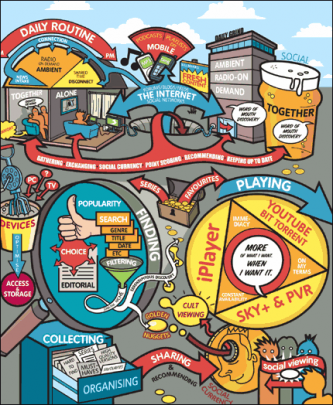
The 'Uses and Gratifications' theory is an approach to understanding why and how people actively seek out specific media to satisfy specific needs. The theory is used to understand mass communication and focuses on the consumer or audience. It states that all media is consumed to fulfil a need. These needs include:

Surveillance - This involves people feeling safer and more secure knowing what things are going on around them
Horror Genre Example: If a viewer was to watch a film in which a serial killer in going around in a ordinary town they would feel that they would be able to handle a situation similar to that if it happened.

Personal Identity - This is the need for the viewer to develop their identity through the use of characters in the media. They adopt desirable characteristics that they think will help better them
Horror Genre Example: If the protagonist in a horror film escapes from a serial killer they have shown bravery so the viewer may want to mirror this act of bravery in their own life.

Personal Relationships - Films are a media type that is considered a social activity as many attend the cinema with each other. This feels a need in that people have watched something together its like they've experienced it together.
Horror Genre Example: Typically in a horror film a character is killed that the audience have grown an emotional attachment to, therefore the viewers emotionally share the tragic experience.

Escapism - is considered the most common need and involves the viewer 'escaping' from the reality of their everyday life as maybe a character in the film. 
Horror Genre Example: The audience can imagine themselves as maybe the villain in the horror film as that is a character they are unlikely to experience in their regular lives.

So why do we like watching horror films?


It's obvious we watch them to be frightened as we get a thrill out of it. When we feel the emotion of being frightened the Amygdala which is a section of the brain that is responsible for detecting fear and preparing for emergency events triggers the 'fight or flight' response which is physiological reaction that occurs in response to a perceived harmful event, attack or threat to survival. Adrenaline pumps around the body and this happens when watching horror films as the amygdala detected fear. 

According to Dr. Jeffrey Goldstein "People go to horror films because they want to be frightened or they wouldn't do it twice. People choose entertainment as they want it to affect them for example people pick comedy films as they want to laugh so people pick horrors as they want to scared and feel the thrill. Horrors have a big effect and they must provide a resolution. Following the usual stereotype "the bad guy" gets it. Although the images are disturbing, the audience has the ability to pay attention and control what effect it has on them emotionally and in other ways.

Dr Glenn Walters had said there are 3 different primary factors that make horror films alluring. The three factors are:

  • Tension - this is generated by suspense mystery, terror, shock and gore
  • Relevance - the audience may relate to personal relevance, cultural meaningfulness and the fear of death
  • Unrealism - this contradicts the second factor, but it's a way for the audience to escape.

movie smile michael jackson watch watching
Walters also looked at the psychological study by Haidt, McCauley and Rozin which is where they showed college students three documentaries. They included cows being slaughtered, a live monkey having its skulls cracked open with a hammer and a child's facial skin being turned inside out in preparation for surgery. 90% of the students turned the videos off before they reached the end, however many of them said they'd think nothing of paying money to see a horror film that includes more than what was featured in the documentary. The conclusion of this was that McCauley discovered that most people who view horror films understand that the events are unreal which furnishes them with psychological distance from the horror portrayed in film.

Wednesday, 28 September 2016

Possible Effects of Horror Films

Image result for uses and gratification theory mediaThe media has become a huge part of our lives and a part of our daily routine. The first thing we do when we wake up is check social media and the last thing we do before we go to bed is check social media. However it's not the only type of media that has a strong effect on us. We go the cinema as a form or entertainment as well as from the comfort of our own homes. We easily pick and learn from people around us as well as things we watch including films. They can have many effects on us whether that be positive or negative. Horror may be considered a negative genre of film as typically negative events occur from serial killers, the arrival of the devil or a zombie apocalypse. 

A possible effect that the genre of Horror could have on its audience is imitation. Imitation is the action of using someone or something as model. Audiences could easily imitate actions of characters shown in horror films and mirror them in real life. A true life example that took place due to watching 'American Psycho'. In 2004, Michael Hernandez aged 14, stabbed his classmate to death after imitating behaviour from the serial killers in American Psycho and The Silence of The Lambs.

Another possible effect of watching horror films could Catharsis. Catharsis is a Greek term that Aristotle used  to describe the performing arts for purging emotions. It is the process of releasing and thereby providing relief from strong or repressed emotions. Watching a horror allows people to escape from the real world and the reality of their lives. They are distracted from their issues and problems that are happening in the world. As the audience feels scared and frightened they release their emotions through this and feel a sense of relief afterwards. Psychologist Freud suggested that horror was appealing because it traffics in 'thoughts and feelings that have been repressed by the ego but seem vaguely familiar'. 

Desensitisation is when the amount of anxiety is reduced by gradually getting used to the object or the situation which causes fear. In terms of media, audiences' reactions have become weaker in terms of reactions to the amount of exposure to violence, death and sex. As some horror films such as the slasher sub-genre contain lots of violence and gore, audiences have slowly become less and less disgusted and shocked by the gruesome acts. The hypodermic syringe model theory suggest that this has happened due to the fact it has simply been accepted by audiences. If the media say something is violent or exposed to us we accept this and as time goes by we become more accustomed to seeing or hearing about violence, death and sex. 

Another possible effect of horror films is cultivation differential also known as Mean World syndrome. Mean World Syndrome is a term made by George Gobner to describe how violence related content of mass media makes audiences believe the world is more dangerous than it actually is. The cultivation theory examines the long-term effects of television and suggests that the film industry distort and cultivates reality. Heavy exposure of horror films could lead audiences to believe that the events of the film are happening in the real world. For example for so many years in horror films, events tend to take place when its dark and night in secluded areas so people have grown to have a fear or dark places such as dark alleys because they've had a negative representation in slasher films for example. Also apocalyptic horror films have lead many to believe that there could be a zombie apocalypse where people have gone to extremes to prepare for this. So this has contribute to cultivating the way society thinks.  

Horror films could also be triggering to audiences such as giving people anxiety or triggering schizophrenia. This is rather rare but their have been reported cases. Some may say there are no long term effects of horror films as we all know that they are fake and not reality. However is this really the case with all the previously discussed effects?

Saturday, 24 September 2016

Horror Through the Decades

 According to Wikipedia Horror films are 'Horror is a film genre seeking to elicit a negative emotional reaction from viewers by playing on the audience's primal fears.'

The first ever horror film was created by film pioneer Georges Melies in the late 1890s as is best known as Le Manoir du Diable. It was a short silent film that was a brief sketch in the style of a theatrical comic fantasy that tell the story of an encounter with Devil. 


Before the 1930s horror was not called horror it was described as Gothic or melodramatic. The 1930s was a decade where many significant films were produced and 1939 in particular was considered to be one of the biggest years in Hollywood. 
The 1930s was filled with political turmoil and economic problems due to the Great Depression and Europe dealing with the fallout out of World War I. The uncertainty of what was to come for the era lead to a popularity of fantastical, escapist fare meaning people wanted to escape reality and retreat to fantasy. This made Universal horror films highly successful. Films such as Frankenstein directed by James Whale and Dracula by Tod Browning were very popular and remain infamous today.


The 1950s was the introduction of the television so studios and companies were determined to put audiences back into the theatre. They began to present films using widescreen and big-approach methods such as Cinemascope, VistaVision and Cinerama. With an interest in science from the atomic bomb that stemmed from the Cold war in 1945, there was an increased interest in outer-space and the genre of Science-Fiction was born. As studios were more interested in making science-fiction and challenging the new television, horror proved to be less important and became B-Movies. B-movies were low budget films or inferior quality made to be shown in cinemas as support for the main film. Horror and science-fiction were combined together and many successful films were produced such as 'The incredible Shrinking Man'.

Many films were produced during the 1960s and the horror genre was its best. The 60s were a time of change and there was a big change in what people perceived as scary/horrible. This was due to the fact two world wars had passed and there was a rethink in everything from hemlines to homosexuality. Taboo, sex and violence were perceived in new ways and shown on cinema screens. Psychological horrors were made beyond the typical Dracula/Frankenstein style such as Psycho(1960) and The Birds(1963) by Alfred Hitchcock who was at the height of his career. At this time Great Britain began producing many horrors with the company Hammer Productions and they became known for their 'Hammer Horrors' one of the being 'Peeping Tom.'


The 1970/80s were money making decades for horror films. The infamous 'The Exorcist' directed by William Friednskin starring Linda Blair was released in '1973'. This decade was also the introduction to the sub genre of "Slasher" films which are films where there are a series of violent assaults or murders by an attacker armed with a knife or such. In 1978 Halloween was released and a precursor to slasher films. Cult films also became popular such as the very well known 'The Texas Chain saw Massacre'. The theme of children and family members being the villain dominated these decades and the idea of 'the enemy from within' was actually found inside your home. This was seen in 'The Shining' and 'The Stepford Wives'. More infamous films that were released during these decades were 'Night of the Living Dead', 'Carrie', 'Friday the 13th' and 'Child's Play' which started off the trend of dolls being featured as the enemy in horror. 


By the 1990s audiences were beginning to find horror hilarious rather than scary. Many did the opposite of what the genre was made to do and were unsuccessful however one that proved popular was 'Silence of the Lambs.' It was a psychological horror and was a sleeper hit that eventually received praise. It sparked a lot of controversy and has accusations of homophobia, transphobia and sexism and some believed that it shouldn't have received its 4 Oscars. Horrors began to become more realistic and there was increase in technology so they also became more advanced. One infamous example that took the realistic approach was 'The Blair Witch Project' released in 1999. Film critics said that the film was an embodiment of horror "modernising its ability to be all - encompassing in expressing fear of American Society." It was a psychological horror that was so realistic that there was a lot of controversy surveying whether the footage was real or made the film. Another infamous film of the 90s was Scream which was released in 1996 and was a crowd pleaser with a sequel being released the following year. It mocked previously made horror films and the stereotypes of the genre.

In the early 2000s the horror film making industry were hit hard after the tragic event of 9/11 as they struggled to come to terms with what was acceptable for public viewing. However they've picked up and have proven to be a very successful genre with 'Paranormal Activity' being the most profitable film made. Horror films have varied in terms of sub-genres, however psychological and paranormal films have been very popular. For example 'The Babadook,' 'The Conjuring' and 'Insidious' Horror films have become more realistic introducing the theme of theme of 'the fear of the unknown'. Many TV Series' have become horror inspired and are very successful such as 'American Horror Story', 'Scream Queens' and 'The Walking Dead'.

Monday, 12 September 2016

Short Films


Firstly what is a short film? A short film is classed as a 'short' if its under 40 minutes. They are usually made with a low budget and have a simple idea and plot line. Many are filmed in one location within a short period of time and tend to deploy the Tordov plot structure. The genre can be identified easier and a lot quicker and a lot of short films tend to have a twist at the end. The

I think one of the elements of a good short film is a simple yet intriguing story line. This is due to the fact the film is short so there may not be enough room for viewers to understand a complex story line meaning they may not find it enjoyable. Another key element to making a good short film is having a twist at the end so it is unpredictable therefore the audience is kept on their toes. Also having a cliffhanger similarly to longer films, tv shows and even books is always more gripping as it leaves the audience with questions and lets them make up idea's of their own.

A short horror film that I watched is The Smiling Man. 


I thought it was a very good and well put together the music intensified as the film progressed which made made a large contribution to the tension. The villain who is the smiling man was only slightly revealed throughout the film until the end where we saw his full body this also created tension and mystery as I was curious as to who was in the house. It featured a child who was being curious, blood and death which are typical features of a horror film. It was also set in it a typical location and wasn't dark and gloomy like your typical horror film. It cleverly used no speech but I still understood what was happening in the film and the visuals completely told the story. 

The Task

Our task this year is to create a short horror film. It must last approximately five minutes and can made up of live action or animation or even a combination of both. Alongside the film we may produce two of the following three options:
  • a poster for the film
  • a radio trailer for the film
  • a film magazine review page featuring the film
By watching, researching and learning about the theory, history and general knowledge of horror films I hope to produce a great piece.