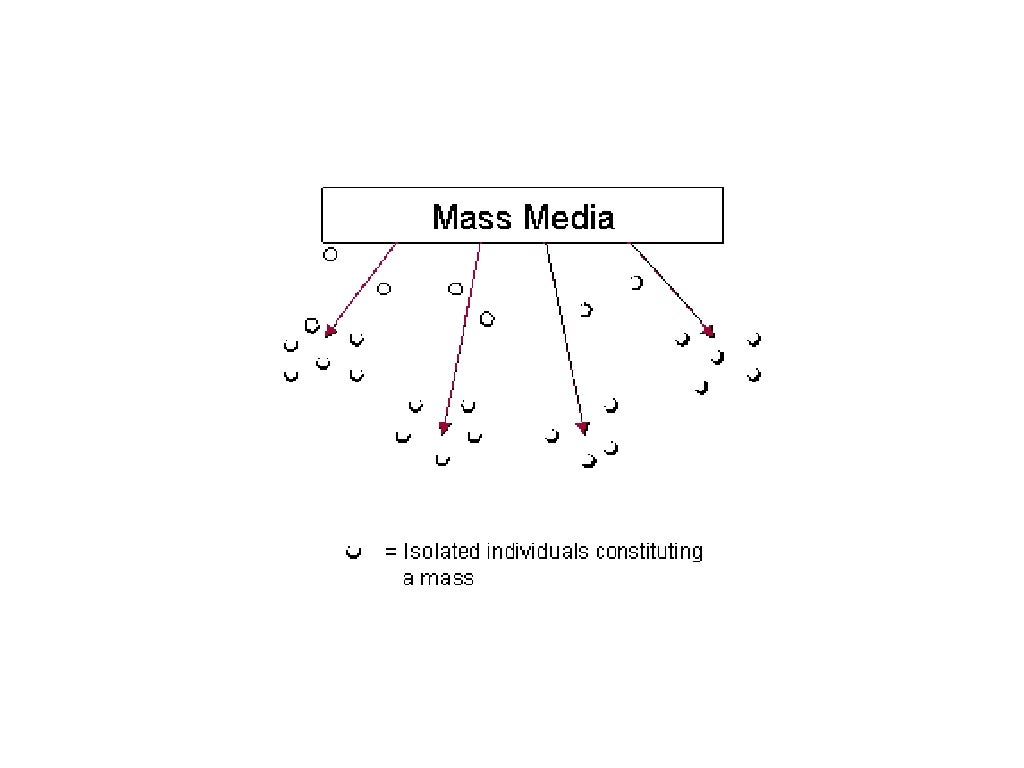
The Hyperdermic Needle Model theory implies that mass media has a direct, immediate and powerful impact/effect on its audiences.
The theory suggests that the mass media could directly influence a large group of people by 'injecting' them with messages that have been designed to trigger a response. It suggest that there is a powerful and direct flow of information from the sender to the receiver. It gives the implication that media messages are injected into passive audiences who are then immediately influenced the message. The theory expresses the dangerous side of the communication in media as the audience is powerless in resisting the impact of the message that has been designed to be sent out. As audiences are passive, there is no escape from the effect of the message in this model and there is no other source of information.
Factors that contribute to the "strong effects" theory of communication include:
- the fast rise and popularisation of radio and television
- the emergence of the persuasion industries such as propaganda and advertising
- the Payne Fund studies that looked at the impact of films on children in 1930s
An example of this taking place in everyday life is the radio version of H.G. Wells' "War of the Worlds." On October 30th 1938, it was broadcasted on the radio as news bulletin interruption. Audiences heard that Martians had begun an invasion on Earth in a town in New Jersey. Approximately 12 millions people in the US heard the broadcast and around 1 million of them believed it was real and began to prepare for a serious alien invasion. Households and religious services were interrupted, traffic jams were caused and communication systems were clogged creating hysteria. People went to seek rural areas for shelter, fleeing their city homes and raiding grocery stores and rationing food.
Media theorists have classified the "War of the Worlds" broadcast as the archetypal example of the hypodermic syringe model. They said the message was "injected into the bloodstream" of the public. The effect of the broadcast demonstrated the power the media has to manipulate the passive public and this was a primary example of ways the audience can shape audience perception.
How does this affect my short film?
As audiences are so easily impacted by what they see in different outlets of media, what I put in my piece will have a direct impact on my audience. If I was making a slasher film the amount of violence in it would have to be noted as members of the audience may copy the actions increasing the amount of danger and crime rate in real life. This also contributes to the age ratings on films, for example a slasher film would have to have a higher age rating as adults are less likely to mimic what they've seen as they clearly know what is wrong from right. As I am making a psychological found-footage short film it is a lot more realistic meaning that audiences will be able to relate to it more deeming it more effective on them. Therefore I must be aware of the message I put into my film to ensure my audience don't have a confusion between reality and what's been made up.